

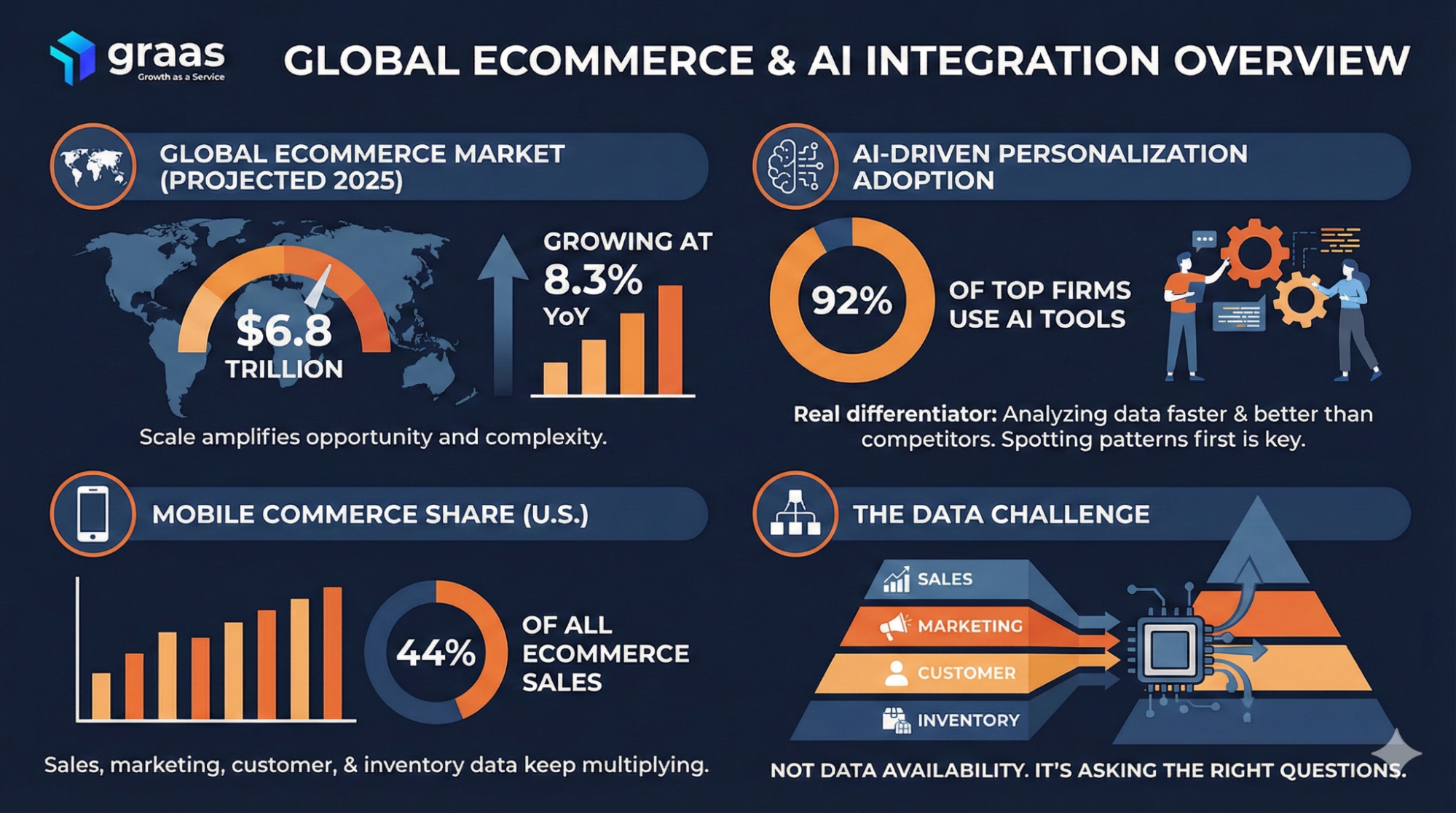
The global eCommerce market was projected to cross $6.8 trillion in 2025, growing at 8.3% year over year. And scale like this doesn’t just amplify opportunity, it amplifies complexity.
Today, 92% of top eCommerce firms already use AI-driven personalization tools, which means the real differentiator is no longer having data, but knowing how to analyze it faster and better than your competitors. Because if they spot patterns before you do, they’ll always be one step ahead with pricing, campaigns, and inventory decisions.
Add to this the fact that mobile commerce now accounts for 44% of all U.S. eCommerce sales, while sales, marketing, customer, and inventory data keep multiplying. The challenge isn’t data availability. It’s asking the right questions.
In this blog, we share practical AI prompts that help you turn raw data into actionable insights. Let’s dive right in!
Before we see the prompts, we must understand why we need them at all. Here’s why:
Strong AI prompts don’t happen by accident. They are deliberately designed to mirror how experienced analysts think - starting with intent, narrowing context, and progressively deepening insight.
Effective prompts are decision-led. Instead of asking AI to “analyze performance,” define what action the analysis should inform - budget reallocation, inventory planning, or campaign optimization. This framing helps AI prioritize insights that actually matter.
AI needs boundaries to reason well. Always include the time window, channels, regions, and core metrics involved. Context narrows the analytical space and reduces irrelevant conclusions, especially when datasets span multiple functions.
Ask AI how to think, not just what to look at. Request comparisons, trend detection, or causal explanations.
Don’t: Analyze my data
Do: Compare week-over-week revenue, highlight anomalies, and explain the likely drivers.
Vague prompts produce surface-level insights. Be explicit about scope, depth, and focus to avoid generic summaries that require rework.
Start with descriptive analysis, then move to diagnostic and predictive prompts once patterns are validated. This mirrors how strong analysts think and helps AI do the same.
Sales data is often the first place teams look, but also where shallow analysis creeps in. The difference between “reporting numbers” and extracting insight lies in how precisely you frame your questions.
Below are practical, high-impact AI prompts designed to surface patterns, diagnose issues, and explain why sales are moving the way they are.
These prompts help with:
Marketing data answers where growth is coming from, but only if it’s analyzed with structure and intent. Instead of pulling disconnected channel reports, these prompts are designed to help you diagnose performance shifts and connect spend to revenue impact across channels and devices.
These prompts help with:
Inventory and product data often reveal problems before they show up in revenue. These prompts are designed to help teams balance supply with demand, identify risk early, and prioritize products that drive profitable growth rather than just volume.
These prompts help with:
Strong AI prompts aren’t written once and forgotten. They evolve as your understanding deepens and as new questions emerge from the data. Treat prompting as an iterative process, much like analysis itself.
Begin with high-level, descriptive prompts to understand overall patterns. Once trends or anomalies appear, narrow your focus by adding constraints such as specific products, channels, or time periods.
Use the first response as a stepping stone. Ask why a change occurred, what factors contributed most, or how results differ across segments. This layered questioning leads to deeper insights.
Summaries tell you what happened. Explanations tell you why. Prompt AI to explain drivers, relationships, and possible causes behind the numbers.
Always sanity-check insights against business knowledge, seasonality, campaigns, or operational changes. AI accelerates analysis but judgment ensures accuracy.
Additional iteration strategies:
Practical AI prompts help eCommerce teams analyze data faster and ask sharper questions. But as data volume and complexity increase, the real challenge shifts from generating insights to acting on them consistently.
While you can experiment with prompts in ChatGPT using uploaded datasets, that approach breaks down quickly at scale. A more reliable path is connecting all your sales and marketing channels through Graas. With Graas’ Hoppr, you can use these prompts on a unified, 360-degree data foundation and get answers you can trust.

From Questions to Charts: Writing Better Prompts for eCommerce Reporting
Baca artikel
Interpreting ROAS drops in Meta, Google, and Marketplaces
Baca artikelPractical AI Prompts for Analyzing eCommerce Data
Baca artikel
AI Prompts to Analyze CNY and Raya/Ramadan eCommerce Performance
Baca artikel
Bagaimana Brand eCommerce Tumbuh Bahkan Tanpa Acara Mega-Sale di Amazon, Flipkart, Myntra, dan D2C
Baca artikelThe global eCommerce market was projected to cross $6.8 trillion in 2025, growing at 8.3% year over year. And scale like this doesn’t just amplify opportunity, it amplifies complexity.
Today, 92% of top eCommerce firms already use AI-driven personalization tools, which means the real differentiator is no longer having data, but knowing how to analyze it faster and better than your competitors. Because if they spot patterns before you do, they’ll always be one step ahead with pricing, campaigns, and inventory decisions.
Add to this the fact that mobile commerce now accounts for 44% of all U.S. eCommerce sales, while sales, marketing, customer, and inventory data keep multiplying. The challenge isn’t data availability. It’s asking the right questions.
In this blog, we share practical AI prompts that help you turn raw data into actionable insights. Let’s dive right in!
Before we see the prompts, we must understand why we need them at all. Here’s why:
Strong AI prompts don’t happen by accident. They are deliberately designed to mirror how experienced analysts think - starting with intent, narrowing context, and progressively deepening insight.
Effective prompts are decision-led. Instead of asking AI to “analyze performance,” define what action the analysis should inform - budget reallocation, inventory planning, or campaign optimization. This framing helps AI prioritize insights that actually matter.
AI needs boundaries to reason well. Always include the time window, channels, regions, and core metrics involved. Context narrows the analytical space and reduces irrelevant conclusions, especially when datasets span multiple functions.
Ask AI how to think, not just what to look at. Request comparisons, trend detection, or causal explanations.
Don’t: Analyze my data
Do: Compare week-over-week revenue, highlight anomalies, and explain the likely drivers.
Vague prompts produce surface-level insights. Be explicit about scope, depth, and focus to avoid generic summaries that require rework.
Start with descriptive analysis, then move to diagnostic and predictive prompts once patterns are validated. This mirrors how strong analysts think and helps AI do the same.
Sales data is often the first place teams look, but also where shallow analysis creeps in. The difference between “reporting numbers” and extracting insight lies in how precisely you frame your questions.
Below are practical, high-impact AI prompts designed to surface patterns, diagnose issues, and explain why sales are moving the way they are.
These prompts help with:
Marketing data answers where growth is coming from, but only if it’s analyzed with structure and intent. Instead of pulling disconnected channel reports, these prompts are designed to help you diagnose performance shifts and connect spend to revenue impact across channels and devices.
These prompts help with:
Inventory and product data often reveal problems before they show up in revenue. These prompts are designed to help teams balance supply with demand, identify risk early, and prioritize products that drive profitable growth rather than just volume.
These prompts help with:
Strong AI prompts aren’t written once and forgotten. They evolve as your understanding deepens and as new questions emerge from the data. Treat prompting as an iterative process, much like analysis itself.
Begin with high-level, descriptive prompts to understand overall patterns. Once trends or anomalies appear, narrow your focus by adding constraints such as specific products, channels, or time periods.
Use the first response as a stepping stone. Ask why a change occurred, what factors contributed most, or how results differ across segments. This layered questioning leads to deeper insights.
Summaries tell you what happened. Explanations tell you why. Prompt AI to explain drivers, relationships, and possible causes behind the numbers.
Always sanity-check insights against business knowledge, seasonality, campaigns, or operational changes. AI accelerates analysis but judgment ensures accuracy.
Additional iteration strategies:
Practical AI prompts help eCommerce teams analyze data faster and ask sharper questions. But as data volume and complexity increase, the real challenge shifts from generating insights to acting on them consistently.
While you can experiment with prompts in ChatGPT using uploaded datasets, that approach breaks down quickly at scale. A more reliable path is connecting all your sales and marketing channels through Graas. With Graas’ Hoppr, you can use these prompts on a unified, 360-degree data foundation and get answers you can trust.
8 Craig Road, Singapore 089668
Email: info@graas.ai
Follow kami di LinkedIn