Graas closes US$17M Series B, acquires Trustana → Read more


AI gave ecommerce better insights. Execution is now the bottleneck.
Your analytics stack flagged a ROAS drop at 9am. By 2pm, someone was still in a Slack thread deciding who owns the fix. By the time bids were adjusted and creatives swapped, two days had passed and the window was gone.
That gap between knowing and doing is the real problem in eCommerce right now. Not data. Not intelligence. Speed of action. Global ecommerce is heading toward $6.88 trillion in 2026, and the AI tools that generate insights are already everywhere. The brands pulling ahead aren't the ones with better dashboards. They're the ones acting on signals before competitors even open the alert.
In this post, you'll learn why execution has become the defining edge in 2026, where the biggest gaps are hiding across the customer journey, and what it looks like when AI agents close the loop automatically.
Let’s dive right in!
For most of the last decade, AI in ecommerce meant better decision support. Dashboards got smarter. Propensity scores replaced gut feel. Anomaly alerts fired when something looked off.
All of it was useful. None of it acted on anything.
Humans still owned the full execution loop: logging into platforms, editing bids, adjusting SKUs, building audiences, updating shipping rules. AI gave you the map. You still had to drive.
Execution-led commerce flips the model. AI agents don't just surface the insight; they own the response. The loop runs on its own: sense a change in performance, decide on the right action within a defined guardrail, execute it.
An agent spots that ad spend on one channel is outperforming plan. It reallocates budget without waiting for a weekly review. Inventory dips below a threshold. Listings update automatically. Shipping capacity shifts. Delivery promises adjust in real time. The human defines the policy. The agent runs it.
This isn't automation in the old sense of "scheduled tasks." It's judgment at speed.
The AI-enabled eCommerce market hit $8.65 billion in 2025 and is forecast to more than double by 2032. Ninety-seven percent of retailers plan to increase AI investment. Over half already use it for customer experience.
At that level of saturation, another insight layer doesn't move the needle. The marginal value of one more dashboard is close to zero when your team is already drowning in recommendations they can't act on fast enough.
The edge now belongs to whoever closes the loop fastest. That's an execution problem, not an intelligence one.
The gap between insight and action doesn't hit equally. It shows up at three specific points in the journey, and each one has a measurable cost.
A 0.1-second improvement in mobile speed can lift retail conversions by 8.4% and increase add-to-cart by 9.1%. That's not a UX nice-to-have. That's a revenue number tied directly to execution quality at the micro-level.
The same logic applies to media spend. Most teams still reshuffle ad budgets in weekly reviews, long after the performance signal has come and gone. Agents can run that reallocation in real time, shifting spend across channels based on live ROAS and current inventory rather than last week's report.
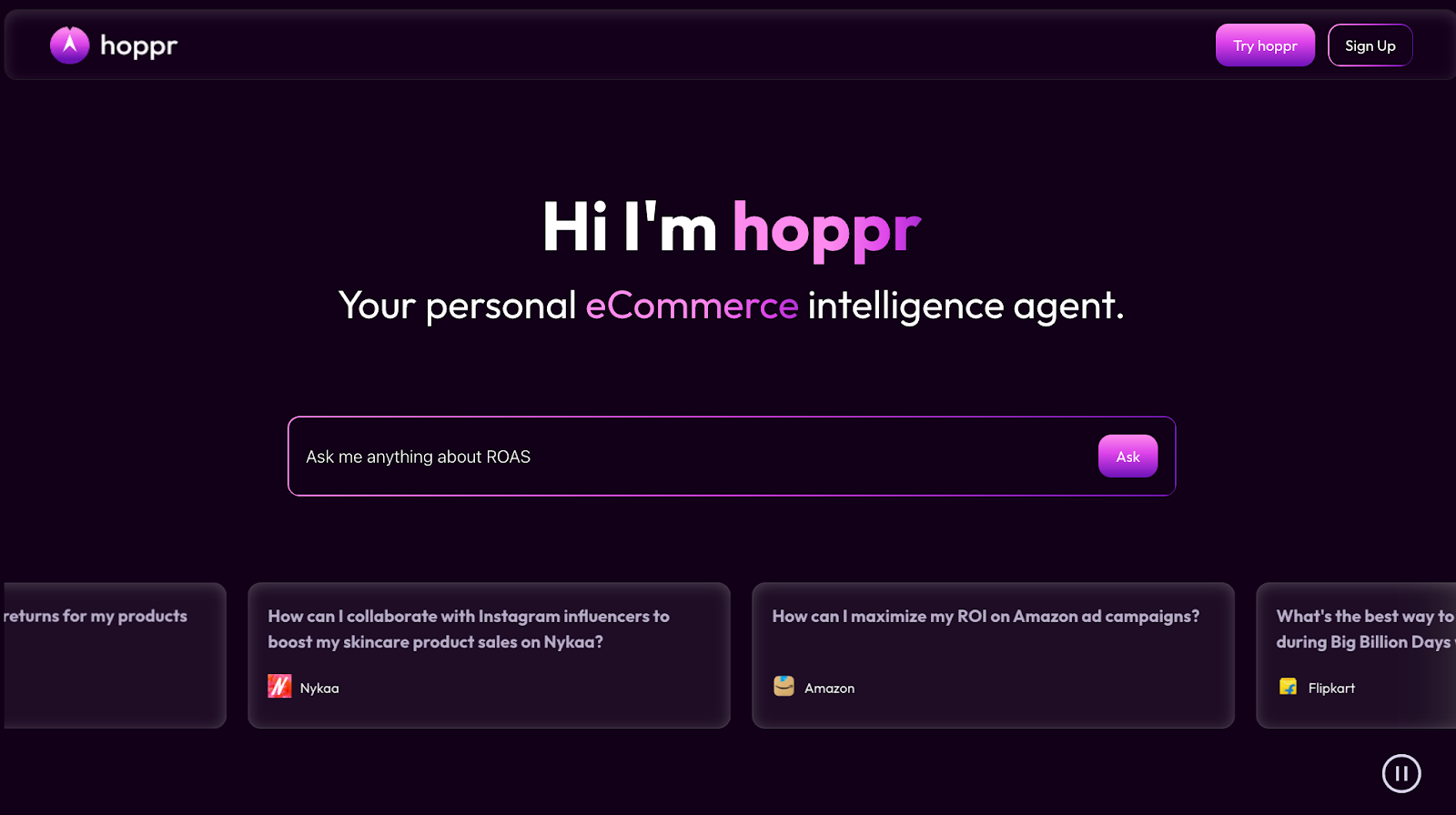
Graas's Execute and Hoppr agents work together here: Hoppr spots which channel or SKU is underperforming, and Execute makes the operational change before the opportunity closes.
Checkout is where execution failures are most expensive. A site loading in one second can convert up to five times better than one loading in ten. 45% percent of shoppers say a slow site makes them less likely to buy. Thirty-six percent say they won't come back.
Beyond speed, 98% of brands expect international order volumes to rise in 2026, many by 11 to 25% year over year. That means more payment complexity, more regional shipping rules, more risk decisions at checkout. Agents can tune payment options, shipping promises, and incentives to each buyer in real time, without waiting for a quarterly CRO project to greenlight the test.
Post-purchase is where most brands are still running on dashboards and delayed reports. An agent watching for late deliveries, repeat support tickets, or a sudden drop in engagement can trigger a retention action before the customer decides to leave.
On the inventory side, agents can rebalance stock and reroute orders based on live demand signals and SLA risk. AI-integrated ops have shown they can cut logistics costs by up to 20% and reduce inventory levels by around 30%. That margin doesn't come from better reporting. It comes from faster, automated decisions.
Experience, revenue, and cost used to be separate workstreams with separate owners. Design owned UX. Growth owned revenue. Finance owned margin. Each team ran its own cycle of analysis, planning, and implementation.
In 2026, they've collapsed into a single question: how fast can you act on a signal?
Speed of execution is now the common thread. A slow response to a performance drop hits experience, revenue, and margin simultaneously. You don't fix one without the others.
This is where the Graas stack operates as a whole. Extract pulls clean, standardised data from over 100 eCommerce sources. Turbo gives teams a unified real-time view of what's happening. Hoppr diagnoses why. Execute closes the loop, making live changes to listings, inventory, orders, and ops without anyone switching between seller centers. From raw data to live action, in one connected system.
The shift to execution-led commerce doesn't just change your stack. It changes how your team operates.
With 97% of retailers planning to increase AI investment and most already using it daily, 2026 is the year practitioners stop clicking buttons and start designing systems. The job is no longer to implement the recommendation. It's to define the guardrails, set the KPIs, and decide when an agent escalates versus acts on its own.
Managing a fleet of agents is a fundamentally different skill than managing a fleet of spreadsheets.
The differentiator in 2026 won't be who has the most tools. It'll be who has the clearest rules for using them. Execution guardrails, approval flows, and audit trails become core infrastructure, not afterthoughts.
Every team running agents needs to be able to answer three questions:
The brands that can answer those questions clearly will move faster and with more confidence than those still debating tool choice.
New titles are already emerging: AI operations manager, agent orchestrator, automation product owner. What they have in common is a shift away from platform-specific certifications toward systems thinking, constraint design, and cross-functional workflow ownership.
The skill that matters most isn't knowing how to use a tool. It's knowing how to build the rules a tool operates within.
The insight problem in eCommerce is largely solved. Data is abundant, dashboards are sophisticated, and AI recommendations are everywhere. What isn't solved is the gap between the recommendation and the live change.
That gap is where revenue leaks. It's where competitors gain ground. And it's where the next generation of eCommerce winners will separate themselves.
Winning teams are the ones who've built systems that act on data automatically, with humans focused on strategy, governance, and the exceptions that genuinely need judgment.
That's the shift Graas is built for. Not another layer of insight on top of an already noisy stack, but a connected system where every signal closes the loop into a live change in campaigns, inventory, listings, or ops. Hoppr spots the problem. Execute fixes it. Extract and Turbo make sure the data feeding both is clean, unified, and current.
If your team is still bridging the gap between insight and action manually, the question isn't whether to change. It's how much that gap has already cost you.
The Retail AI Index 2026: How 100 Enterprises Are Adopting AI
Read more
WhatsApp Chatbots vs AI Sales Agents: Which Drives Higher Conversions for eCommerce Brands?
Read more
How brands use WhatsApp for eCommerce in SEA: The role of AI agents in driving conversions
Read more
From Browsing to Chat: Why Conversations Are Driving eCommerce
Read more
The ROI of Centralizing Marketplace Operations with Execute
Read moreAI gave ecommerce better insights. Execution is now the bottleneck.
Your analytics stack flagged a ROAS drop at 9am. By 2pm, someone was still in a Slack thread deciding who owns the fix. By the time bids were adjusted and creatives swapped, two days had passed and the window was gone.
That gap between knowing and doing is the real problem in eCommerce right now. Not data. Not intelligence. Speed of action. Global ecommerce is heading toward $6.88 trillion in 2026, and the AI tools that generate insights are already everywhere. The brands pulling ahead aren't the ones with better dashboards. They're the ones acting on signals before competitors even open the alert.
In this post, you'll learn why execution has become the defining edge in 2026, where the biggest gaps are hiding across the customer journey, and what it looks like when AI agents close the loop automatically.
Let’s dive right in!
For most of the last decade, AI in ecommerce meant better decision support. Dashboards got smarter. Propensity scores replaced gut feel. Anomaly alerts fired when something looked off.
All of it was useful. None of it acted on anything.
Humans still owned the full execution loop: logging into platforms, editing bids, adjusting SKUs, building audiences, updating shipping rules. AI gave you the map. You still had to drive.
Execution-led commerce flips the model. AI agents don't just surface the insight; they own the response. The loop runs on its own: sense a change in performance, decide on the right action within a defined guardrail, execute it.
An agent spots that ad spend on one channel is outperforming plan. It reallocates budget without waiting for a weekly review. Inventory dips below a threshold. Listings update automatically. Shipping capacity shifts. Delivery promises adjust in real time. The human defines the policy. The agent runs it.
This isn't automation in the old sense of "scheduled tasks." It's judgment at speed.
The AI-enabled eCommerce market hit $8.65 billion in 2025 and is forecast to more than double by 2032. Ninety-seven percent of retailers plan to increase AI investment. Over half already use it for customer experience.
At that level of saturation, another insight layer doesn't move the needle. The marginal value of one more dashboard is close to zero when your team is already drowning in recommendations they can't act on fast enough.
The edge now belongs to whoever closes the loop fastest. That's an execution problem, not an intelligence one.
The gap between insight and action doesn't hit equally. It shows up at three specific points in the journey, and each one has a measurable cost.
A 0.1-second improvement in mobile speed can lift retail conversions by 8.4% and increase add-to-cart by 9.1%. That's not a UX nice-to-have. That's a revenue number tied directly to execution quality at the micro-level.
The same logic applies to media spend. Most teams still reshuffle ad budgets in weekly reviews, long after the performance signal has come and gone. Agents can run that reallocation in real time, shifting spend across channels based on live ROAS and current inventory rather than last week's report.
Graas's Execute and Hoppr agents work together here: Hoppr spots which channel or SKU is underperforming, and Execute makes the operational change before the opportunity closes.
Checkout is where execution failures are most expensive. A site loading in one second can convert up to five times better than one loading in ten. 45% percent of shoppers say a slow site makes them less likely to buy. Thirty-six percent say they won't come back.
Beyond speed, 98% of brands expect international order volumes to rise in 2026, many by 11 to 25% year over year. That means more payment complexity, more regional shipping rules, more risk decisions at checkout. Agents can tune payment options, shipping promises, and incentives to each buyer in real time, without waiting for a quarterly CRO project to greenlight the test.
Post-purchase is where most brands are still running on dashboards and delayed reports. An agent watching for late deliveries, repeat support tickets, or a sudden drop in engagement can trigger a retention action before the customer decides to leave.
On the inventory side, agents can rebalance stock and reroute orders based on live demand signals and SLA risk. AI-integrated ops have shown they can cut logistics costs by up to 20% and reduce inventory levels by around 30%. That margin doesn't come from better reporting. It comes from faster, automated decisions.
Experience, revenue, and cost used to be separate workstreams with separate owners. Design owned UX. Growth owned revenue. Finance owned margin. Each team ran its own cycle of analysis, planning, and implementation.
In 2026, they've collapsed into a single question: how fast can you act on a signal?
Speed of execution is now the common thread. A slow response to a performance drop hits experience, revenue, and margin simultaneously. You don't fix one without the others.
This is where the Graas stack operates as a whole. Extract pulls clean, standardised data from over 100 eCommerce sources. Turbo gives teams a unified real-time view of what's happening. Hoppr diagnoses why. Execute closes the loop, making live changes to listings, inventory, orders, and ops without anyone switching between seller centers. From raw data to live action, in one connected system.
The shift to execution-led commerce doesn't just change your stack. It changes how your team operates.
With 97% of retailers planning to increase AI investment and most already using it daily, 2026 is the year practitioners stop clicking buttons and start designing systems. The job is no longer to implement the recommendation. It's to define the guardrails, set the KPIs, and decide when an agent escalates versus acts on its own.
Managing a fleet of agents is a fundamentally different skill than managing a fleet of spreadsheets.
The differentiator in 2026 won't be who has the most tools. It'll be who has the clearest rules for using them. Execution guardrails, approval flows, and audit trails become core infrastructure, not afterthoughts.
Every team running agents needs to be able to answer three questions:
The brands that can answer those questions clearly will move faster and with more confidence than those still debating tool choice.
New titles are already emerging: AI operations manager, agent orchestrator, automation product owner. What they have in common is a shift away from platform-specific certifications toward systems thinking, constraint design, and cross-functional workflow ownership.
The skill that matters most isn't knowing how to use a tool. It's knowing how to build the rules a tool operates within.
The insight problem in eCommerce is largely solved. Data is abundant, dashboards are sophisticated, and AI recommendations are everywhere. What isn't solved is the gap between the recommendation and the live change.
That gap is where revenue leaks. It's where competitors gain ground. And it's where the next generation of eCommerce winners will separate themselves.
Winning teams are the ones who've built systems that act on data automatically, with humans focused on strategy, governance, and the exceptions that genuinely need judgment.
That's the shift Graas is built for. Not another layer of insight on top of an already noisy stack, but a connected system where every signal closes the loop into a live change in campaigns, inventory, listings, or ops. Hoppr spots the problem. Execute fixes it. Extract and Turbo make sure the data feeding both is clean, unified, and current.
If your team is still bridging the gap between insight and action manually, the question isn't whether to change. It's how much that gap has already cost you.
© 2026 Graas AI
Offices: Singapore | India | Indonesia | Australia | Malaysia | Philippines | Thailand | UAE | Vietnam