Graas closes US$17M Series B, acquires Trustana → Read more


A few years ago, if you told someone their next purchase would be decided by a model trained on text, you'd have been laughed out of the room. Today, that's exactly how shopping is starting to work.
ChatGPT now has close to 900 million weekly users, and 61% of consumers have already used generative AI tools like ChatGPT for online shopping. Closer to home, conversational commerce GMV in Southeast Asia is expected to hit US$23 billion in 2027, with 40% of Thai and 36% of Vietnamese consumers already making purchases through this system.
The old browse-to-buy journey was simple: search, browse, checkout. The new one has a lot more back-and-forth baked into it: message, maybe message again, ask more questions, decide, and then buy.
Chat is becoming the entry point of eCommerce. And if you want your eCommerce business to do well through this change in consumer behaviour, you need to understand how these conversations actually drive conversion. Let's dive right in.
Conversational commerce wasn't invented by AI. Long before ChatGPT existed, sellers in Jakarta were taking orders through Facebook Messenger and negotiating prices on WhatsApp.
According to a McKinsey study, this kind of "informal selling" generated up to USD 3 billion in Indonesia in 2017 and that was before eCommerce platforms became mainstream in the region.
So when generative AI arrived and made chat-based shopping a global trend, brands in Southeast Asia and India weren't learning a new behaviour. They were watching the rest of the world catch up.
India is the largest WhatsApp market on the planet. The country has somewhere between 535.8M and 853.8M monthly active users, with about 97% penetration among smartphone users. Indonesia adds another 112 million users, the Philippines another 88 million. Thailand leans on LINE. Vietnam runs on Zalo. The app changes, but the pattern is identical: one messaging platform dominates daily life.
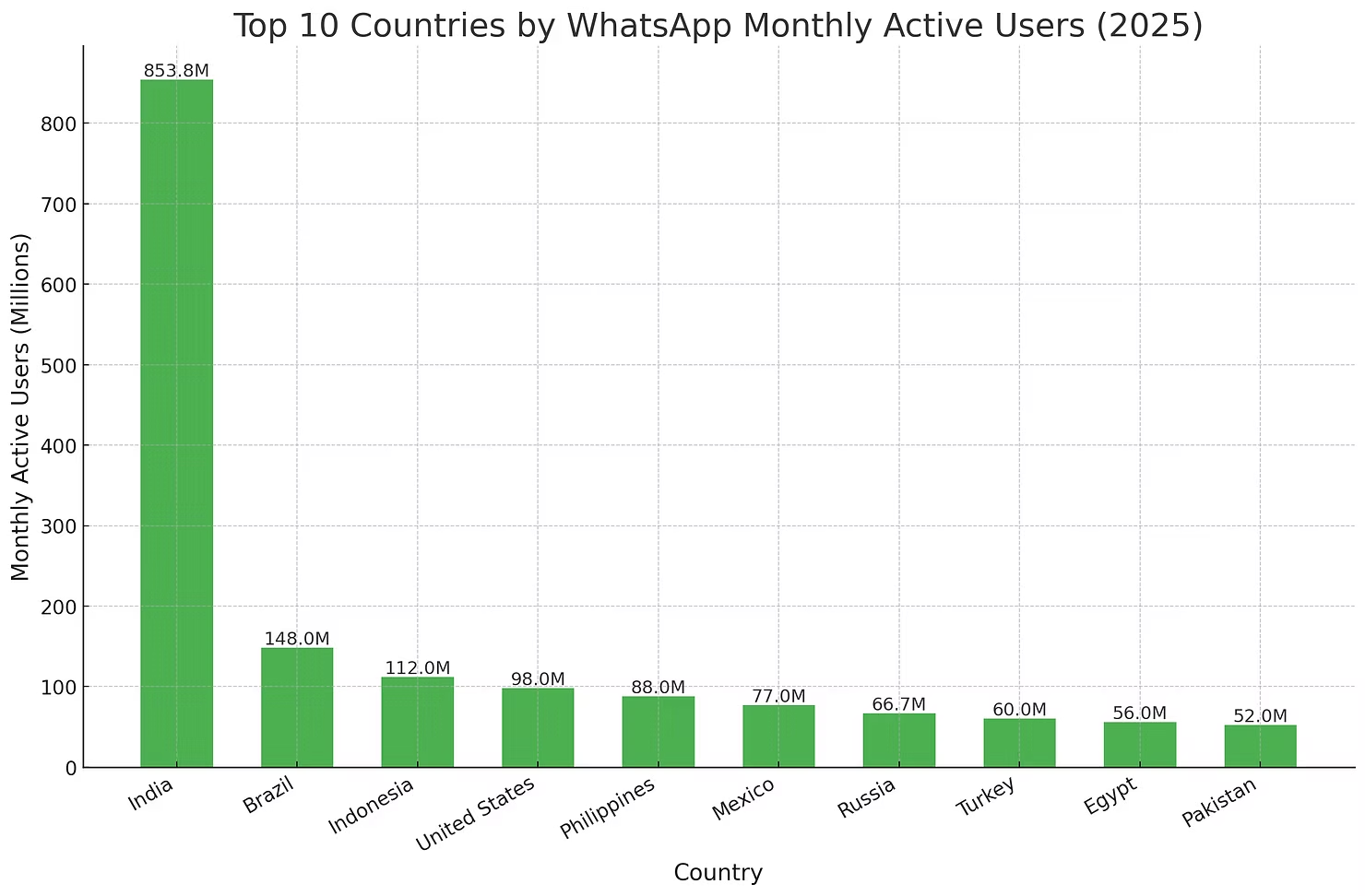
This matters because 91% of all conversational AI interactions in 2025 took place on WhatsApp, and Indian users spend an average of 17 hours a month inside the app. When buyers already live inside one chat window, brands just need to show up there.
Most Western markets built their eCommerce stack on desktops and bolted on mobile later. SEA and India did the opposite. 59.2% of Asian internet users connect to the internet exclusively or primarily via smartphone, and in India, 85.5% of households possess at least one smartphone.
That changes how people shop. A buyer browsing on a small screen while commuting doesn't want to scroll through fourteen filters and a comparison grid. They want to ask one question and get an answer. Chat fits that need almost perfectly because it's compact, native to mobile, and doesn't make the user learn a new layout for every store they visit.
There's a cultural layer to this too. In much of SEA and India, buying things by chatting with someone is normal. People haggle with their local grocer over the phone, send a WhatsApp voice note to confirm an order, or message a tailor with a fabric photo.
A BCG and Facebook study found that Southeast Asia has surpassed the US, Mexico, India, and Brazil in both awareness and adoption of conversational commerce.
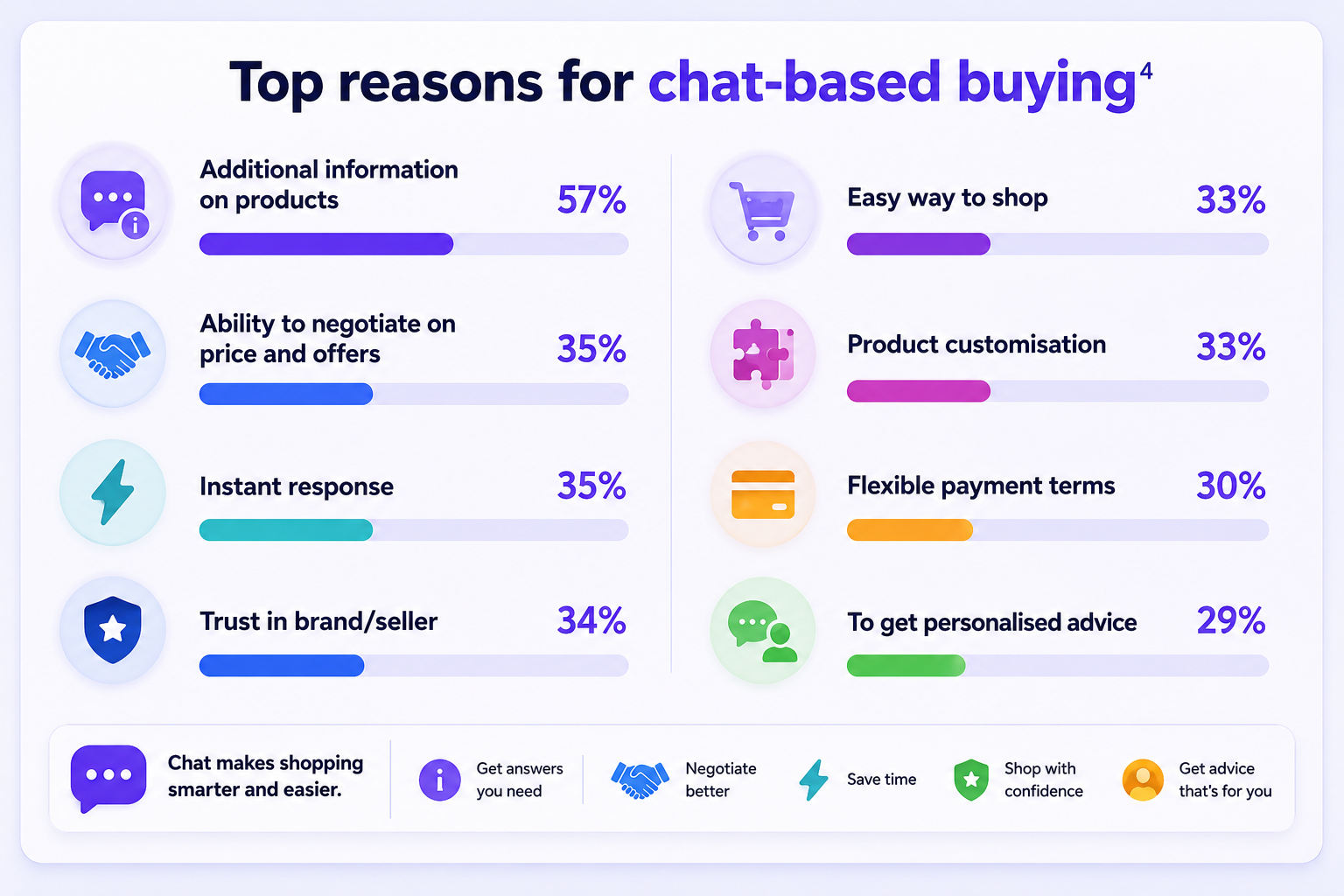
Thailand led with 40% of respondents having undertaken a conversational commerce transaction, followed by Vietnam (36%), Indonesia (29%), Malaysia (26%) and the Philippines (23%). And 69% of shoppers across Southeast Asia credit their discovery of conversational commerce to a social media post, link or advertisement.
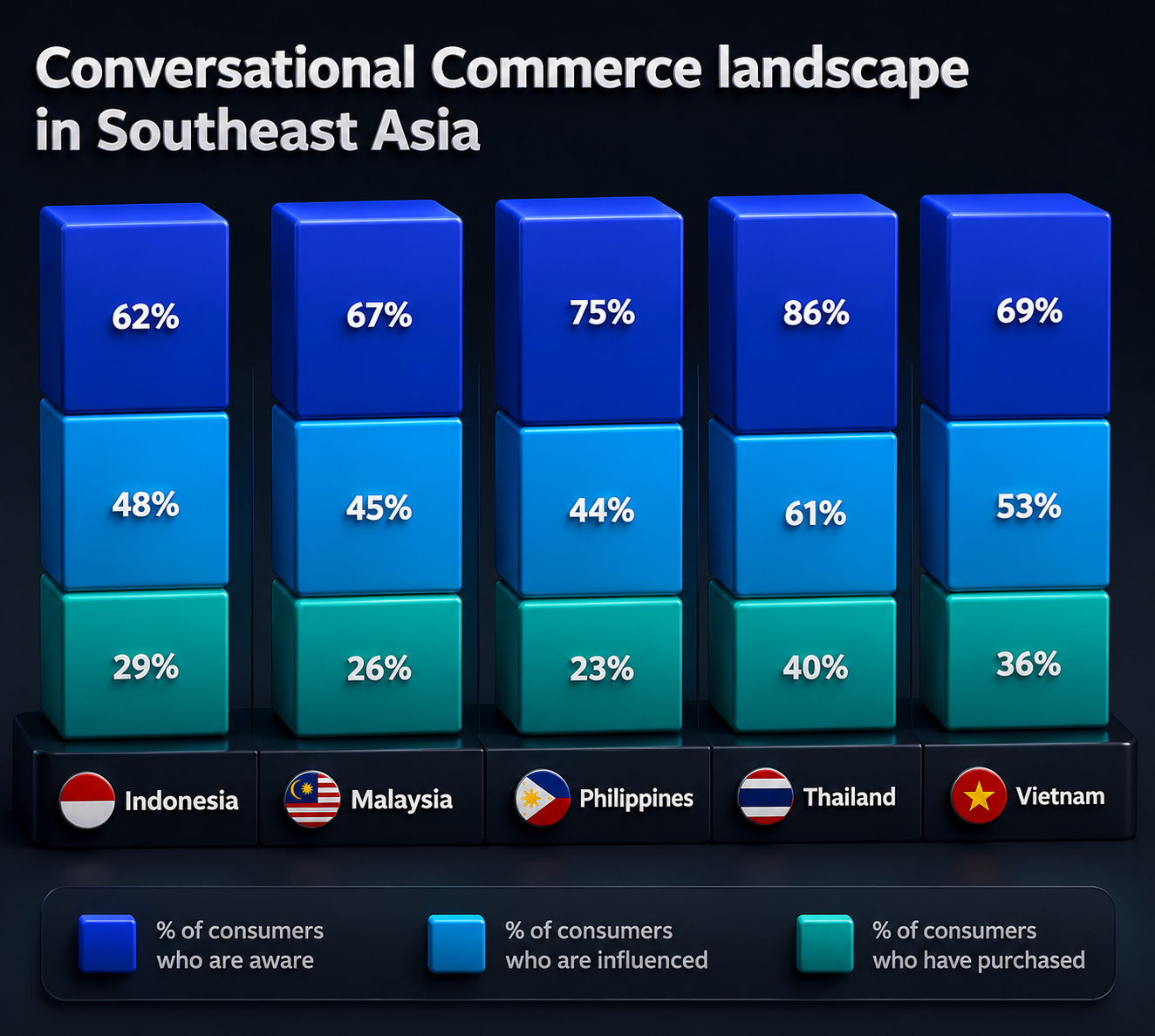
For brands operating in these markets, chat is where conversion already happens. The question is whether your storefront can handle thousands of these conversations at once without breaking, repeating itself, or losing the thread.
Once a buyer starts shopping by chatting, three things change quickly, which most stores aren't built for. The product page, the search bar, and the support ticket are all losing ground.
The product page used to do the explaining. Now, before adding anything to a cart, buyers want to ask: Will this work for my skin type? Does it ship to Surabaya in three days? What's the return policy in India? Reading is being replaced by interrogation, and the brands that answer fast are the ones converting.
ChatGPT has reset the clock. A four-hour email response or a "we'll get back to you within 24 hours" auto-responder feels broken now. Buyers have been conditioned to expect answers in seconds, and they treat slow replies as a sign that the brand isn't serious about their business. Even on WhatsApp, where reply windows used to be relaxed, the standard has tightened.
Browsing is exhausting. Fifteen open tabs, three Reddit threads, and a YouTube review later, most shoppers want someone to just tell them what to buy. Guided chat takes the decision fatigue out. Instead of "here are 80 options, good luck," a buyer can say "I have oily skin and a budget of 800 rupees" and walk away with one clear recommendation.
eCommerce used to be a self-service model, but with AI doing what only AI can do at scale, the model has become very assisted.
If buyer behavior has moved from self-service to assisted, the storefront hasn't kept up. Most eCommerce stacks were designed for a quieter, slower buyer who already knew what they wanted before landing on the page. That buyer is becoming rare, and the cracks are showing in three places.
The product page is a brochure. It lists what the product is and hopes that's enough. But it can't react. A shopper asking "is this safe for sensitive skin?" has to scroll, search, or DM the brand on Instagram. By the time they get an answer, half the interest has cooled off. A page that can't answer questions is a page that loses sales.
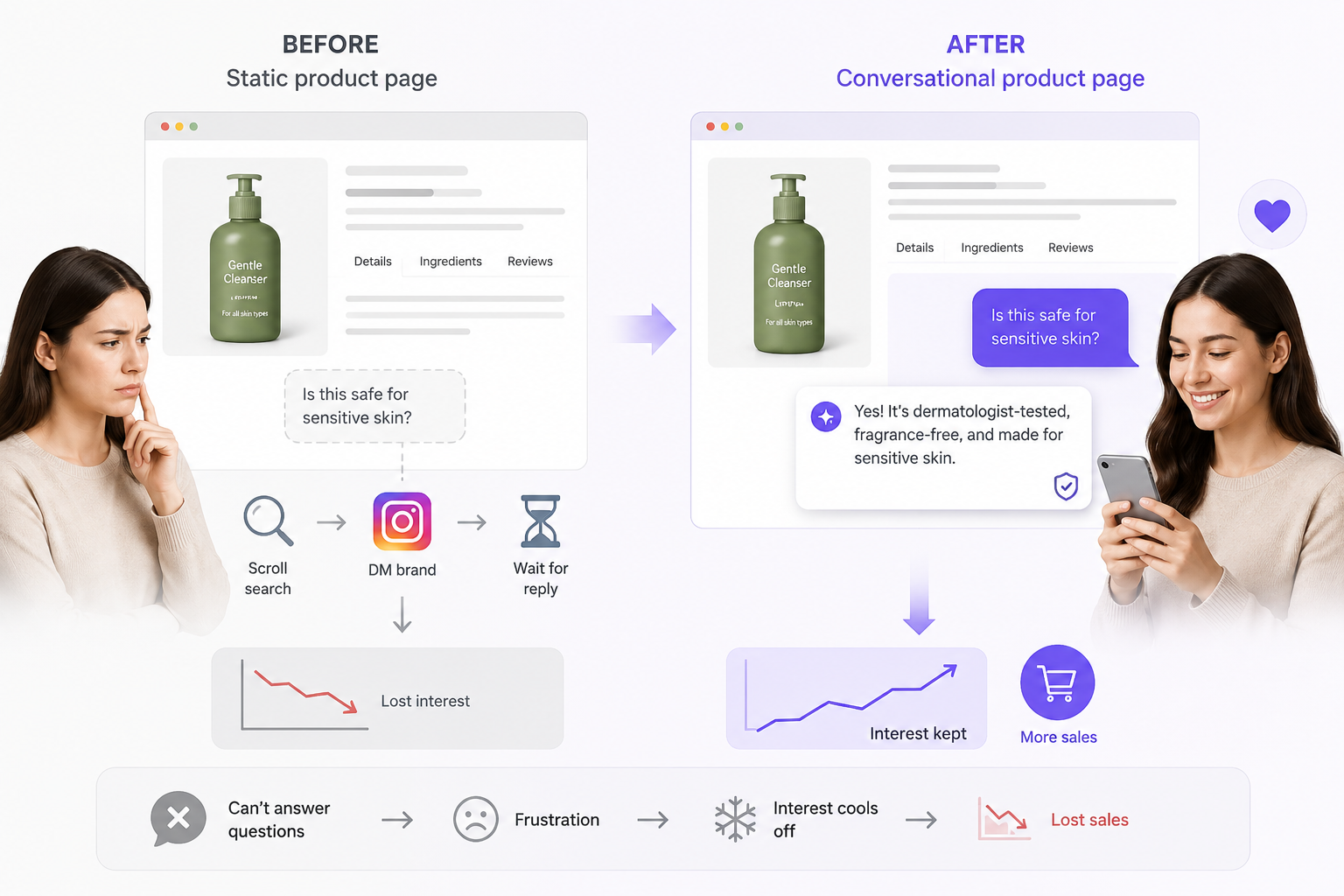
Even with a chatbot bolted on, most storefronts can't hold a real conversation. The bot answers one query and then forgets the context. The buyer asks a follow-up and gets a canned link to the FAQ. The handoff to a human takes minutes. None of it feels like talking to a salesperson, and that disconnect is exactly what high-intent buyers notice.
Most analytics dashboards show the same pattern: heavy traffic, decent add-to-cart, then a cliff at checkout. The drop-off is a confidence problem. Buyers reach a decision point with two or three unanswered questions and just leave, often into the inbox of a competitor's WhatsApp number. These websites are not converting proactively, more so at a scale that is possible.
So chat is where conversion happens. The obvious response is to put a team on WhatsApp, hire more reps, and start replying. That works until volume hits.
Once a brand grows past a few hundred conversations a day, manual chat stops scaling. Reps get slow. Replies during a sale event arrive after the buyer has already bought something else. Two agents answer the same question three different ways, sometimes with different prices. New hires take weeks to learn the catalog properly. And on Diwali or 11.11, when volume spikes 10x overnight, the inbox piles up with unanswered messages and lost orders by the hour.
Manual chat is slow, inconsistent, and impossible to scale past a certain point. The brands trying to win conversational commerce with bigger CX teams alone keep hitting the same wall: more people doesn't solve a structural problem. It just spreads the cost of it.
For most of the last decade, "chat on a website" meant a basic rules-based bot that handed off to a human within two messages. It worked for FAQs. Buying conversations need more than that. AI agents change the math because they can hold context, pull live product and inventory data, and respond in seconds at any volume.
Speed is the biggest unlock here. A good AI agent answers within seconds, regardless of whether 5 or 5,000 buyers are messaging at the same time. There's no queue, no shift handover, and no "we'll get back to you tomorrow" lag.
For a brand running a campaign across Shopee, Lazada, and TikTok Shop, this is the difference between catching the buyer at peak intent or losing them to whoever replied faster.
In a market where the average shopper has three tabs open and four brands DMed at once, replying second is often the same as not replying at all.
A static product page can't ask follow-ups. An AI agent can.
Trained on the brand's catalog, inventory, order history, and policies, an AI agent can do what a good in-store associate does. It narrows the choice down instead of dumping all 80 options on the buyer.
All-e by Graas, for example, holds context across follow-ups and answers questions based on a brand's actual inventory and policies, instead of falling back on a generic FAQ tree.
The third unlock is volume. A human team plateaus. An AI agent doesn't. Whether it's a regular Tuesday or 11.11, the agent handles every inbound message in parallel without breaking, repeating itself, or going silent. All-e is built to resolve 80 to 90 percent of repetitive buyer queries automatically across Shopee, Lazada, Tokopedia, and TikTok Shop, escalating only the edge cases with full context to human agents. Headcount reduction is the wrong way to think about this. The real point is being present everywhere buyers expect a reply, without dropping any of them.
What this means for brands: Be where your customers already are (WhatsApp, Shopee, Lazada, TikTok). Reply in real time and guide buyers to the right product instead of just listing what you sell.
This is not to say browsing is irrelevant. It has stopped being where most buying journeys begin. The new starting point is a question, asked in a chat window, on whatever app the buyer happens to be in. The brands winning this shift are the ones treating conversations as the actual storefront and building the infrastructure to handle them at scale.
Explore how AI agents like Graas’ All-e are helping brands turn conversations into scalable sales channels. Get in touch today!

The Retail AI Index 2026: How 100 Enterprises Are Adopting AI
Read more
WhatsApp Chatbots vs AI Sales Agents: Which Drives Higher Conversions for eCommerce Brands?
Read more
How brands use WhatsApp for eCommerce in SEA: The role of AI agents in driving conversions
Read moreFrom Browsing to Chat: Why Conversations Are Driving eCommerce
Read more
The ROI of Centralizing Marketplace Operations with Execute
Read moreA few years ago, if you told someone their next purchase would be decided by a model trained on text, you'd have been laughed out of the room. Today, that's exactly how shopping is starting to work.
ChatGPT now has close to 900 million weekly users, and 61% of consumers have already used generative AI tools like ChatGPT for online shopping. Closer to home, conversational commerce GMV in Southeast Asia is expected to hit US$23 billion in 2027, with 40% of Thai and 36% of Vietnamese consumers already making purchases through this system.
The old browse-to-buy journey was simple: search, browse, checkout. The new one has a lot more back-and-forth baked into it: message, maybe message again, ask more questions, decide, and then buy.
Chat is becoming the entry point of eCommerce. And if you want your eCommerce business to do well through this change in consumer behaviour, you need to understand how these conversations actually drive conversion. Let's dive right in.
Conversational commerce wasn't invented by AI. Long before ChatGPT existed, sellers in Jakarta were taking orders through Facebook Messenger and negotiating prices on WhatsApp.
According to a McKinsey study, this kind of "informal selling" generated up to USD 3 billion in Indonesia in 2017 and that was before eCommerce platforms became mainstream in the region.
So when generative AI arrived and made chat-based shopping a global trend, brands in Southeast Asia and India weren't learning a new behaviour. They were watching the rest of the world catch up.
India is the largest WhatsApp market on the planet. The country has somewhere between 535.8M and 853.8M monthly active users, with about 97% penetration among smartphone users. Indonesia adds another 112 million users, the Philippines another 88 million. Thailand leans on LINE. Vietnam runs on Zalo. The app changes, but the pattern is identical: one messaging platform dominates daily life.
This matters because 91% of all conversational AI interactions in 2025 took place on WhatsApp, and Indian users spend an average of 17 hours a month inside the app. When buyers already live inside one chat window, brands just need to show up there.
Most Western markets built their eCommerce stack on desktops and bolted on mobile later. SEA and India did the opposite. 59.2% of Asian internet users connect to the internet exclusively or primarily via smartphone, and in India, 85.5% of households possess at least one smartphone.
That changes how people shop. A buyer browsing on a small screen while commuting doesn't want to scroll through fourteen filters and a comparison grid. They want to ask one question and get an answer. Chat fits that need almost perfectly because it's compact, native to mobile, and doesn't make the user learn a new layout for every store they visit.
There's a cultural layer to this too. In much of SEA and India, buying things by chatting with someone is normal. People haggle with their local grocer over the phone, send a WhatsApp voice note to confirm an order, or message a tailor with a fabric photo.
A BCG and Facebook study found that Southeast Asia has surpassed the US, Mexico, India, and Brazil in both awareness and adoption of conversational commerce.
Thailand led with 40% of respondents having undertaken a conversational commerce transaction, followed by Vietnam (36%), Indonesia (29%), Malaysia (26%) and the Philippines (23%). And 69% of shoppers across Southeast Asia credit their discovery of conversational commerce to a social media post, link or advertisement.
For brands operating in these markets, chat is where conversion already happens. The question is whether your storefront can handle thousands of these conversations at once without breaking, repeating itself, or losing the thread.
Once a buyer starts shopping by chatting, three things change quickly, which most stores aren't built for. The product page, the search bar, and the support ticket are all losing ground.
The product page used to do the explaining. Now, before adding anything to a cart, buyers want to ask: Will this work for my skin type? Does it ship to Surabaya in three days? What's the return policy in India? Reading is being replaced by interrogation, and the brands that answer fast are the ones converting.
ChatGPT has reset the clock. A four-hour email response or a "we'll get back to you within 24 hours" auto-responder feels broken now. Buyers have been conditioned to expect answers in seconds, and they treat slow replies as a sign that the brand isn't serious about their business. Even on WhatsApp, where reply windows used to be relaxed, the standard has tightened.
Browsing is exhausting. Fifteen open tabs, three Reddit threads, and a YouTube review later, most shoppers want someone to just tell them what to buy. Guided chat takes the decision fatigue out. Instead of "here are 80 options, good luck," a buyer can say "I have oily skin and a budget of 800 rupees" and walk away with one clear recommendation.
eCommerce used to be a self-service model, but with AI doing what only AI can do at scale, the model has become very assisted.
If buyer behavior has moved from self-service to assisted, the storefront hasn't kept up. Most eCommerce stacks were designed for a quieter, slower buyer who already knew what they wanted before landing on the page. That buyer is becoming rare, and the cracks are showing in three places.
The product page is a brochure. It lists what the product is and hopes that's enough. But it can't react. A shopper asking "is this safe for sensitive skin?" has to scroll, search, or DM the brand on Instagram. By the time they get an answer, half the interest has cooled off. A page that can't answer questions is a page that loses sales.
Even with a chatbot bolted on, most storefronts can't hold a real conversation. The bot answers one query and then forgets the context. The buyer asks a follow-up and gets a canned link to the FAQ. The handoff to a human takes minutes. None of it feels like talking to a salesperson, and that disconnect is exactly what high-intent buyers notice.
Most analytics dashboards show the same pattern: heavy traffic, decent add-to-cart, then a cliff at checkout. The drop-off is a confidence problem. Buyers reach a decision point with two or three unanswered questions and just leave, often into the inbox of a competitor's WhatsApp number. These websites are not converting proactively, more so at a scale that is possible.
So chat is where conversion happens. The obvious response is to put a team on WhatsApp, hire more reps, and start replying. That works until volume hits.
Once a brand grows past a few hundred conversations a day, manual chat stops scaling. Reps get slow. Replies during a sale event arrive after the buyer has already bought something else. Two agents answer the same question three different ways, sometimes with different prices. New hires take weeks to learn the catalog properly. And on Diwali or 11.11, when volume spikes 10x overnight, the inbox piles up with unanswered messages and lost orders by the hour.
Manual chat is slow, inconsistent, and impossible to scale past a certain point. The brands trying to win conversational commerce with bigger CX teams alone keep hitting the same wall: more people doesn't solve a structural problem. It just spreads the cost of it.
For most of the last decade, "chat on a website" meant a basic rules-based bot that handed off to a human within two messages. It worked for FAQs. Buying conversations need more than that. AI agents change the math because they can hold context, pull live product and inventory data, and respond in seconds at any volume.
Speed is the biggest unlock here. A good AI agent answers within seconds, regardless of whether 5 or 5,000 buyers are messaging at the same time. There's no queue, no shift handover, and no "we'll get back to you tomorrow" lag.
For a brand running a campaign across Shopee, Lazada, and TikTok Shop, this is the difference between catching the buyer at peak intent or losing them to whoever replied faster.
In a market where the average shopper has three tabs open and four brands DMed at once, replying second is often the same as not replying at all.
A static product page can't ask follow-ups. An AI agent can.
Trained on the brand's catalog, inventory, order history, and policies, an AI agent can do what a good in-store associate does. It narrows the choice down instead of dumping all 80 options on the buyer.
All-e by Graas, for example, holds context across follow-ups and answers questions based on a brand's actual inventory and policies, instead of falling back on a generic FAQ tree.
The third unlock is volume. A human team plateaus. An AI agent doesn't. Whether it's a regular Tuesday or 11.11, the agent handles every inbound message in parallel without breaking, repeating itself, or going silent. All-e is built to resolve 80 to 90 percent of repetitive buyer queries automatically across Shopee, Lazada, Tokopedia, and TikTok Shop, escalating only the edge cases with full context to human agents. Headcount reduction is the wrong way to think about this. The real point is being present everywhere buyers expect a reply, without dropping any of them.
What this means for brands: Be where your customers already are (WhatsApp, Shopee, Lazada, TikTok). Reply in real time and guide buyers to the right product instead of just listing what you sell.
This is not to say browsing is irrelevant. It has stopped being where most buying journeys begin. The new starting point is a question, asked in a chat window, on whatever app the buyer happens to be in. The brands winning this shift are the ones treating conversations as the actual storefront and building the infrastructure to handle them at scale.
Explore how AI agents like Graas’ All-e are helping brands turn conversations into scalable sales channels. Get in touch today!
© 2026 Graas AI
Offices: Singapore | India | Indonesia | Australia | Malaysia | Philippines | Thailand | UAE | Vietnam