Graas closes US$17M Series B, acquires Trustana → Read more


Across Southeast Asia, around 64% of retail businesses using WhatsApp Business report that the platform now generates more than 15% of total sales, and some digital-native brands attribute over 40% of revenue to WhatsApp-initiated conversations. Indonesia alone has 112 million WhatsApp users; the Philippines has 88 million.

This is what conversational commerce looks like in practice. Buyers ask questions, get recommendations, place orders, and pay inside the same chat thread. WhatsApp used to be where brands handled shipping queries and "where is my order?" tickets. Today it's where revenue gets created.
The shift from support channel to sales channel is already underway. What's changed is how brands handle the volume and intent flowing through the channel, which is what this piece covers.
A few patterns explain why WhatsApp converts so well in SEA. Each one starts in chat and ends in a sale.
Buyers ask for a category or a price range, and the brand sends back a curated list with images and prices. 78% of retail WhatsApp Business users maintain active catalogs that customers can browse directly within conversations. The path from "looking for" to "show me" is short.
A skincare brand gets a message: "I have oily skin and breakouts, what should I use under ₹800?" The agent replies with two product options, asks about routine, and confirms a recommendation. This is clienteling at scale. WhatsApp orders show 18% higher average order values compared to app-based orders, partly because guided recommendations land better than search results.
With AI in the loop, orders stay inside the thread. The agent confirms quantity, applies pricing, and triggers payment without pushing the buyer to a separate checkout. This is the natural extension of how SEA shoppers already buy.
Abandoned cart nudges, restock alerts, and post-purchase upsells run in the same thread as the original conversation. WhatsApp messages enjoy a 98% open rate, which is why a timed nudge here recovers revenue that email rarely touches.
A WhatsApp number gets you in the door. Scaling what happens after the first message is where most brands stall. The issues split cleanly into two buckets: the operational load on human teams, and the limits of basic chatbot tooling.

The first version of WhatsApp commerce usually runs on people. A few reps in a shared inbox, copying product details, prices, and stock from another tab. This works for a few hundred messages a day. It cracks at a few thousand.
Buyers on WhatsApp expect a reply in minutes. And it means no deal if you take hours. When a question sits unanswered for 30 minutes, the intent has already moved on. By the time the brand replies with the right product and price, the conversation has gone cold.
Every new market, language, and SKU adds headcount. Brands operating across India, Indonesia, Thailand, Vietnam, and the Philippines need fluency in each one. Training and staffing to keep up with chat volume gets expensive fast, and most CX teams hit a hard ceiling on what people can handle in a day.
That's the operational side. The chatbot side has its own ceiling.
Menu-based bots ask the buyer to pick from numbered options. That works for FAQ routing. It breaks the moment someone types "I'm looking for something for sensitive skin around ₹500." Free-text intent confuses these bots, and the buyer has to learn the bot's language instead of the other way around.
Basic bots match keywords. They miss that "anything under ₹2,000 for daily wear" is a constrained product search with two filters baked in. When the buyer rephrases or follows up, the bot loses context and resets to the start.
Real purchases involve trade-offs. Size, color, bundle, delivery date, payment method. A scripted flow handles one or two of these. Add a fourth variable and the conversation breaks down, and the buyer leaves.
So the messages land, the open rates look great, and the orders that should be there aren't.
AI agents handle the chat differently from scripted bots. They read intent, hold context across turns, recommend based on what the buyer has actually said, and complete the order inside the thread.
Shoppers who engage with AI-powered chat convert at 12.3% compared to just 3.1% for those who don't, which is roughly a 4x lift. The mechanics behind that number are worth understanding.
Discovery on WhatsApp starts with a vague intent. "Something for my mom's birthday." "A laptop bag for a 14-inch screen." "Cleanser for combination skin."
An AI agent parses the intent, asks one or two clarifying questions, and pulls back a tight set of options. This works because the agent connects to the live catalog and inventory. It knows what's in stock, what fits the constraint, and what the buyer has looked at before.
The shopper gets three relevant options instead of thirty, which is the difference between a conversation and a search results page.
When the buyer has a purchase history, the agent uses it. A returning customer asking about skincare gets recommendations that build on what they bought last time. A wholesale buyer placing a reorder gets prices tied to their account, their credit limit, and their active schemes.
Graas's All-e is built around this exact pattern. The conversational commerce agent identifies the stakeholder, whether a retailer, distributor, field agent, or end consumer, and then pulls their purchase history, targets, credit limits, and eligible schemes. The recommendation maps to who is asking, with their pricing and their context baked in.
This is where most chats die. The buyer has the right option in front of them and stalls. They want to compare. They want to confirm. They want to check delivery.
An AI agent moves the conversation forward without pushing. It answers the next question before it gets asked. It offers a bundle when the basket is close to a price tier. It confirms delivery dates against the buyer's pincode.
With All-e, once the buyer says yes, the agent validates available credit, applies live pricing, creates the order directly in the ERP, and sends the invoice back in the same chat. Dispatch and delivery updates land in the same thread. The buyer never leaves WhatsApp.
Conversational AI can help improve conversion rates by 20% in online retail, and proactive AI prompts recover 35% of abandoned carts, against the 5-15% typical for email or retargeting. The reason is timing and channel. A WhatsApp nudge lands while the intent is still warm, on the same surface where the conversation started.
AI agents handle the follow-up at scale. Restock alerts go to people who asked about an out-of-stock SKU. Reorder reminders trigger on the buyer's usage cycle. Cart recovery messages reference the exact product the buyer was looking at, not a generic "you left something behind" template.
What ties all of this together is context. The agent doesn't reset between messages. The thread from "do you have this in blue?" to "send me an invoice for 200 of those" stays continuous, and the buyer never has to repeat their address, their name, or their last order.
The numbers across SEA tell a clear story. AI in the chat lifts every metric that matters in commerce.
Personalized recommendations can lift eCommerce revenue by 5-15%, and businesses that excel with AI-driven personalization see up to 40% more revenue. Combined with WhatsApp's 98% open rate, the compounding effect is sharper than any other channel. Shoppers engaging with AI chat already convert at 4x the rate of those who don't.

A buyer who would have taken three days to compare options and order finishes the same job in one conversation. Advanced conversational AI now handles 93% of customer questions without requiring human escalation, so the buyer rarely waits for a rep to come online. Decision-to-purchase compresses from days to minutes.
Conversational AI delivers substantial cost savings, helping companies reduce customer service costs by 15% to 70% depending on implementation. For SEA brands running multi-market support, the impact shows up across every language team. A small CX team handles the volume that previously took a much larger one, and human reps focus on the conversations that need judgment.
The hardest part of WhatsApp commerce was scale. More markets meant more reps, more handoffs, more mistakes. AI agents change the math. Adding a new SKU, language, or market no longer means proportional headcount. Graas's infrastructure scales 20x on sale days without manual intervention, which is the kind of headroom WhatsApp commerce needs during 9.9, 10.10, and 11.11.
The bar for WhatsApp commerce in SEA has moved. Presence on the channel was the starting line three years ago. Conversion is the measure now.
The brands pulling 20 to 40% of revenue through WhatsApp got there by treating every conversation as a sales surface. Their agents understand intent, pull from live inventory, and close orders inside the thread without losing context.
See how All-e helps brands turn WhatsApp into a high-converting sales channel.

The Retail AI Index 2026: How 100 Enterprises Are Adopting AI
Read more
WhatsApp Chatbots vs AI Sales Agents: Which Drives Higher Conversions for eCommerce Brands?
Read moreHow brands use WhatsApp for eCommerce in SEA: The role of AI agents in driving conversions
Read more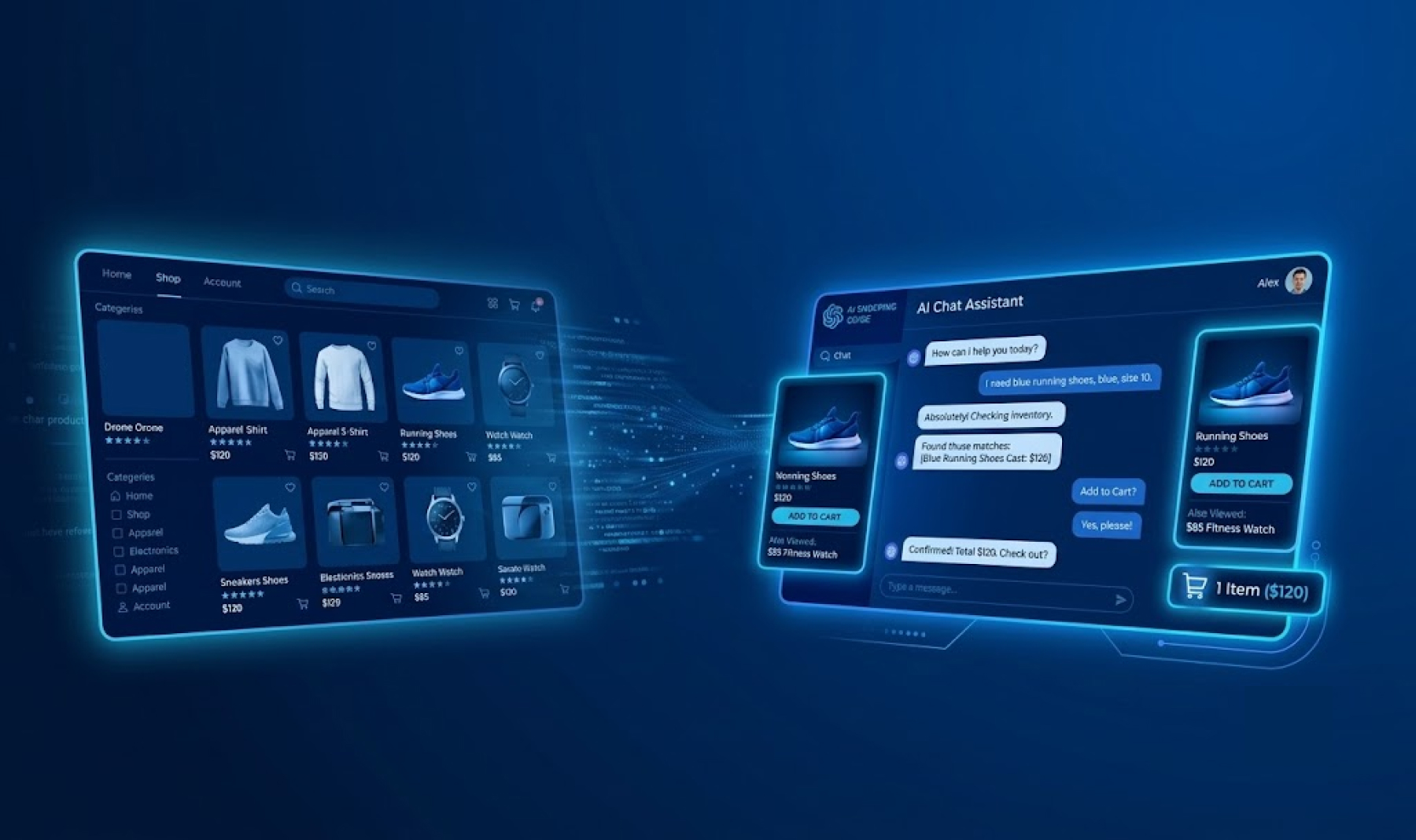
From Browsing to Chat: Why Conversations Are Driving eCommerce
Read more
The ROI of Centralizing Marketplace Operations with Execute
Read moreAcross Southeast Asia, around 64% of retail businesses using WhatsApp Business report that the platform now generates more than 15% of total sales, and some digital-native brands attribute over 40% of revenue to WhatsApp-initiated conversations. Indonesia alone has 112 million WhatsApp users; the Philippines has 88 million.
This is what conversational commerce looks like in practice. Buyers ask questions, get recommendations, place orders, and pay inside the same chat thread. WhatsApp used to be where brands handled shipping queries and "where is my order?" tickets. Today it's where revenue gets created.
The shift from support channel to sales channel is already underway. What's changed is how brands handle the volume and intent flowing through the channel, which is what this piece covers.
A few patterns explain why WhatsApp converts so well in SEA. Each one starts in chat and ends in a sale.
Buyers ask for a category or a price range, and the brand sends back a curated list with images and prices. 78% of retail WhatsApp Business users maintain active catalogs that customers can browse directly within conversations. The path from "looking for" to "show me" is short.
A skincare brand gets a message: "I have oily skin and breakouts, what should I use under ₹800?" The agent replies with two product options, asks about routine, and confirms a recommendation. This is clienteling at scale. WhatsApp orders show 18% higher average order values compared to app-based orders, partly because guided recommendations land better than search results.
With AI in the loop, orders stay inside the thread. The agent confirms quantity, applies pricing, and triggers payment without pushing the buyer to a separate checkout. This is the natural extension of how SEA shoppers already buy.
Abandoned cart nudges, restock alerts, and post-purchase upsells run in the same thread as the original conversation. WhatsApp messages enjoy a 98% open rate, which is why a timed nudge here recovers revenue that email rarely touches.
A WhatsApp number gets you in the door. Scaling what happens after the first message is where most brands stall. The issues split cleanly into two buckets: the operational load on human teams, and the limits of basic chatbot tooling.
The first version of WhatsApp commerce usually runs on people. A few reps in a shared inbox, copying product details, prices, and stock from another tab. This works for a few hundred messages a day. It cracks at a few thousand.
Buyers on WhatsApp expect a reply in minutes. And it means no deal if you take hours. When a question sits unanswered for 30 minutes, the intent has already moved on. By the time the brand replies with the right product and price, the conversation has gone cold.
Every new market, language, and SKU adds headcount. Brands operating across India, Indonesia, Thailand, Vietnam, and the Philippines need fluency in each one. Training and staffing to keep up with chat volume gets expensive fast, and most CX teams hit a hard ceiling on what people can handle in a day.
That's the operational side. The chatbot side has its own ceiling.
Menu-based bots ask the buyer to pick from numbered options. That works for FAQ routing. It breaks the moment someone types "I'm looking for something for sensitive skin around ₹500." Free-text intent confuses these bots, and the buyer has to learn the bot's language instead of the other way around.
Basic bots match keywords. They miss that "anything under ₹2,000 for daily wear" is a constrained product search with two filters baked in. When the buyer rephrases or follows up, the bot loses context and resets to the start.
Real purchases involve trade-offs. Size, color, bundle, delivery date, payment method. A scripted flow handles one or two of these. Add a fourth variable and the conversation breaks down, and the buyer leaves.
So the messages land, the open rates look great, and the orders that should be there aren't.
AI agents handle the chat differently from scripted bots. They read intent, hold context across turns, recommend based on what the buyer has actually said, and complete the order inside the thread.
Shoppers who engage with AI-powered chat convert at 12.3% compared to just 3.1% for those who don't, which is roughly a 4x lift. The mechanics behind that number are worth understanding.
Discovery on WhatsApp starts with a vague intent. "Something for my mom's birthday." "A laptop bag for a 14-inch screen." "Cleanser for combination skin."
An AI agent parses the intent, asks one or two clarifying questions, and pulls back a tight set of options. This works because the agent connects to the live catalog and inventory. It knows what's in stock, what fits the constraint, and what the buyer has looked at before.
The shopper gets three relevant options instead of thirty, which is the difference between a conversation and a search results page.
When the buyer has a purchase history, the agent uses it. A returning customer asking about skincare gets recommendations that build on what they bought last time. A wholesale buyer placing a reorder gets prices tied to their account, their credit limit, and their active schemes.
Graas's All-e is built around this exact pattern. The conversational commerce agent identifies the stakeholder, whether a retailer, distributor, field agent, or end consumer, and then pulls their purchase history, targets, credit limits, and eligible schemes. The recommendation maps to who is asking, with their pricing and their context baked in.
This is where most chats die. The buyer has the right option in front of them and stalls. They want to compare. They want to confirm. They want to check delivery.
An AI agent moves the conversation forward without pushing. It answers the next question before it gets asked. It offers a bundle when the basket is close to a price tier. It confirms delivery dates against the buyer's pincode.
With All-e, once the buyer says yes, the agent validates available credit, applies live pricing, creates the order directly in the ERP, and sends the invoice back in the same chat. Dispatch and delivery updates land in the same thread. The buyer never leaves WhatsApp.
Conversational AI can help improve conversion rates by 20% in online retail, and proactive AI prompts recover 35% of abandoned carts, against the 5-15% typical for email or retargeting. The reason is timing and channel. A WhatsApp nudge lands while the intent is still warm, on the same surface where the conversation started.
AI agents handle the follow-up at scale. Restock alerts go to people who asked about an out-of-stock SKU. Reorder reminders trigger on the buyer's usage cycle. Cart recovery messages reference the exact product the buyer was looking at, not a generic "you left something behind" template.
What ties all of this together is context. The agent doesn't reset between messages. The thread from "do you have this in blue?" to "send me an invoice for 200 of those" stays continuous, and the buyer never has to repeat their address, their name, or their last order.
The numbers across SEA tell a clear story. AI in the chat lifts every metric that matters in commerce.
Personalized recommendations can lift eCommerce revenue by 5-15%, and businesses that excel with AI-driven personalization see up to 40% more revenue. Combined with WhatsApp's 98% open rate, the compounding effect is sharper than any other channel. Shoppers engaging with AI chat already convert at 4x the rate of those who don't.
A buyer who would have taken three days to compare options and order finishes the same job in one conversation. Advanced conversational AI now handles 93% of customer questions without requiring human escalation, so the buyer rarely waits for a rep to come online. Decision-to-purchase compresses from days to minutes.
Conversational AI delivers substantial cost savings, helping companies reduce customer service costs by 15% to 70% depending on implementation. For SEA brands running multi-market support, the impact shows up across every language team. A small CX team handles the volume that previously took a much larger one, and human reps focus on the conversations that need judgment.
The hardest part of WhatsApp commerce was scale. More markets meant more reps, more handoffs, more mistakes. AI agents change the math. Adding a new SKU, language, or market no longer means proportional headcount. Graas's infrastructure scales 20x on sale days without manual intervention, which is the kind of headroom WhatsApp commerce needs during 9.9, 10.10, and 11.11.
The bar for WhatsApp commerce in SEA has moved. Presence on the channel was the starting line three years ago. Conversion is the measure now.
The brands pulling 20 to 40% of revenue through WhatsApp got there by treating every conversation as a sales surface. Their agents understand intent, pull from live inventory, and close orders inside the thread without losing context.
See how All-e helps brands turn WhatsApp into a high-converting sales channel.
© 2026 Graas AI
Offices: Singapore | India | Indonesia | Australia | Malaysia | Philippines | Thailand | UAE | Vietnam