Graas closes US$17M Series B, acquires Trustana → Read more


Most eCommerce brands selling in Southeast Asia and India are already on WhatsApp. Most have also built a chatbot. Queries get answered, orders trickle in, and yet conversions stay flat or worse, inconsistent month after month.
The reason is simple once you see it. Chatbots are built to respond, not to sell. They greet, route, share product links, maybe push a coupon, and then hand off to a human or a webstore. That handoff is where buyers drop. A customer who asked about a product on WhatsApp at 10pm rarely comes back to complete checkout on a website at 11.
Every dropped session is a paid acquisition cost that did not convert. Across a quarter, that becomes real money walking out the door.
This blog breaks down where chatbots stop, what AI sales agents do differently, and which approach actually drives consistent conversions for eCommerce brands today. Let’s dive right in!
To understand why, it helps to look at what each tool is actually built to do.
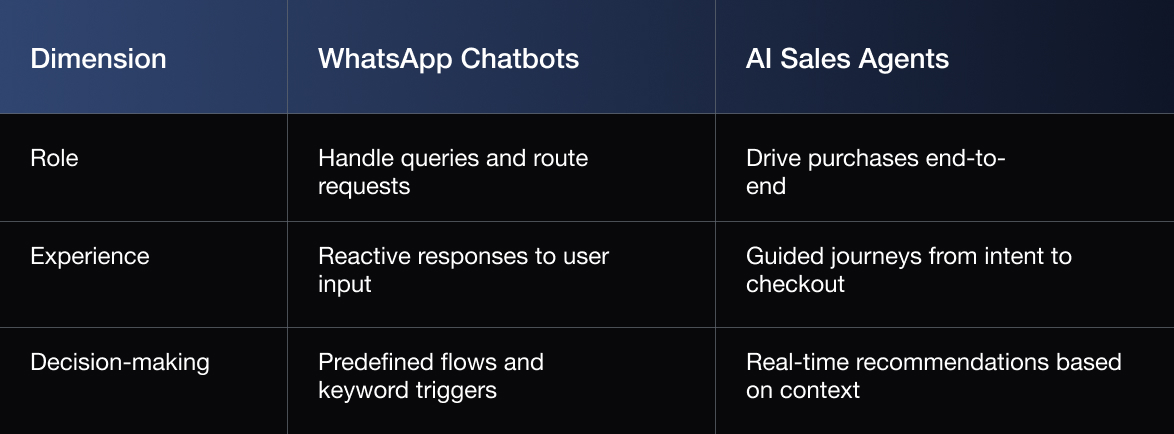
Chatbots were designed to handle inbound queries efficiently. A buyer asks about a price, shipping time, or return policy, and the bot fetches the answer. That is useful, but it is customer service, not sales. AI sales agents are built around a different goal. They treat every conversation as a potential transaction and work toward closing it, the way a good store associate would on the shop floor.
A chatbot follows a flow someone wrote in advance. If a customer goes off-script, the conversation breaks. An AI sales agent reads context as it unfolds: who is asking, what they bought before, what is in stock, and which offer applies. Based on that, it recommends the right product, applies the relevant scheme, and moves the conversation toward checkout without a handoff.
This shift, from reactive responses to guided selling, is where most of the conversion gap opens up.
These differences are not theoretical. They show up in the exact moments that decide whether a buyer converts or bounces.
A buyer messages asking which protein powder is best for weight loss. A chatbot returns a list of top sellers or redirects them to the catalog. The buyer now has to browse and decide alone, and most do not.
An AI agent reads the intent, factors in what the buyer has purchased before, and asks one clarifying question: "Are you looking for something post-workout or as a meal replacement?" Based on the answer, it surfaces two options with a short reason for each. The buyer has a clear path forward.
A customer adds a product to cart inside the chat and then goes quiet. A chatbot does nothing or fires a generic "Complete your order!" prompt.
An AI agent picks up the signal differently. It checks whether the hesitation follows a price look, a delivery question, or a comparison browse, and responds accordingly. It might surface a relevant offer, clarify a return policy, or simply re-engage at the right moment. That context-awareness is what turns a stalled session into a closed order.
"What is the difference between these two models?" is a question every eCommerce brand gets daily. A chatbot cannot answer it meaningfully. It links out to product pages and leaves the buyer to figure it out on their own.
An AI agent handles the comparison in-chat. It highlights the differentiators that matter based on what the buyer has already said they need, removes the options that do not fit, and helps them reach a decision. The conversation stays in one place, and so does the buyer.
Drop-offs happen. The question is what comes next. With a chatbot, the session ends and the intent is lost. There is no recovery because there is no memory of what the conversation contained.
An AI agent retains context across sessions. When the buyer returns, it picks up where things left off. It knows what was browsed, what was asked, and what caused the hesitation. That continuity is often the difference between a lost lead and a completed purchase.
The performance gap is real across millions of shopping sessions and multiple independent studies, brands that move from reactive chatbots to AI sales agents see measurable lifts in the three areas that matter most to eCommerce growth teams.
Shoppers who engage with AI-powered chat convert at 12.3%, compared to 3.1% for those who browse without it, a four-fold difference that shows up directly in revenue. AI-driven personalization compounds this further, with research pointing to conversion rate lifts of up to 23% when the agent understands who is browsing and what they actually need.
Basic chatbots do not produce these numbers. They handle queries, but they do not guide decisions. The lift comes specifically when the agent reads intent, surfaces the right product at the right moment, and removes friction before a buyer has a reason to leave. Worth noting: 64% of AI-powered sales in conversational commerce come from first-time shoppers, which suggests AI agents build purchase confidence faster with buyers who have no prior relationship with the brand.
Shoppers complete purchases 47% faster when assisted by an AI agent compared to unassisted sessions or those handled by a basic chatbot. That is not a marginal efficiency gain. It reflects what happens when a buyer does not need to switch between product pages, wait for a human to pick up, or restart a conversation they abandoned mid-way.
Speed matters in conversational commerce more than it does in most other channels. A buyer who arrives with intent can be gone within minutes if the experience creates friction. AI agents compress the time between "interested" and "purchased" by staying contextually useful throughout the session, rather than routing the buyer out of it.
Cart abandonment sits at roughly 70% across eCommerce globally. AI agents that proactively engage buyers showing exit signals recover around 35% of those carts, according to analysis of over 17 million shopping sessions. That is revenue a passive chatbot cannot reclaim because it has no mechanism to detect hesitation or respond to it in real time.
The impact compounds with returning buyers too. Customers who engage with AI chat during a session spend 25% more than those who do not, driven by relevant suggestions and in-conversation support that extends the interaction beyond a single-item purchase.
These numbers make the case plainly. AI sales agents are not a better version of a chatbot. They are a different tool entirely, built to convert rather than just respond.
Most conversational tools in eCommerce stop at the conversation. All-e, Graas's AI sales agent, is built to go further, combining three layers of intelligence that work together behind every message: who the customer is, what they need, and what makes commercial sense for the transaction.
All-e identifies the stakeholder before anything else. Whether the message comes from a distributor placing a bulk order, a retailer checking stock, a field agent logging a secondary sale, or an end consumer browsing for a product, All-e reads the context and responds accordingly.
This goes beyond user segmentation. All-e pulls the customer's purchase history, credit limits, active targets, and eligible schemes before it responds. A distributor asking about a product gets an answer shaped by their credit standing and pricing tier. A consumer asking the same question gets a personalized recommendation based on what they bought before. Same input, different output, because the customer profile is different.
All-e is trained on the brand's catalog, not a generic product database. It understands SKU-level detail, bundle configurations, current stock positions, and product specifications well enough to make accurate comparisons and relevant recommendations inside the conversation.
When a buyer asks which variant to pick or whether a product is available in a specific configuration, All-e gives a direct answer. It does not redirect to a product page or suggest they browse the catalog.
This is where All-e separates itself from most conversational tools. It does not just surface information. It applies the commercial logic behind every transaction: current pricing, customer-specific schemes, available credit, and active promotions, all in real time.
An order that goes through All-e is not just a conversation output. It is a credit-validated, scheme-applied, correctly priced transaction that flows directly into the brand's ERP, CRM, or DMS without manual entry on either side.
Once an order is confirmed, All-e generates an invoice inside the chat, confirms dispatch, and tracks delivery, keeping the full order lifecycle within the same conversation. There is no transfer to a separate system or a support team for standard transactions.
For brands managing high order volumes across WhatsApp and other channels, this means fewer dropped sessions, less reconciliation work, and a buyer experience that feels complete from first message to fulfilled order.
Most eCommerce brands are already on WhatsApp. So are their competitors. Being on the channel stopped being an advantage the moment everyone got there.
What separates brands that convert from those that just respond is not the channel. It is the intelligence behind it. Whether a buyer is comparing products, hesitating before checkout, or placing a bulk order at midnight, an AI sales agent like All-e handles the conversation and closes it.
See how All-e helps brands turn their WhatsApp channel into a high-converting sales channel. Contact Us!
WhatsApp Chatbots vs AI Sales Agents: Which Drives Higher Conversions for eCommerce Brands?
Baca artikel
How brands use WhatsApp for eCommerce in SEA: The role of AI agents in driving conversions
Baca artikel
Dari Browsing Menjadi Chat: Alasan Percakapan Mendorong eCommerce
Baca artikel
ROI dari Sentralisasi Operasional Marketplace dengan Turbo
Baca artikel
Cara Brand Enterprise Mengelola Inventory di Shopee, Lazada, dan TikTok Shop
Baca artikelMost eCommerce brands selling in Southeast Asia and India are already on WhatsApp. Most have also built a chatbot. Queries get answered, orders trickle in, and yet conversions stay flat or worse, inconsistent month after month.
The reason is simple once you see it. Chatbots are built to respond, not to sell. They greet, route, share product links, maybe push a coupon, and then hand off to a human or a webstore. That handoff is where buyers drop. A customer who asked about a product on WhatsApp at 10pm rarely comes back to complete checkout on a website at 11.
Every dropped session is a paid acquisition cost that did not convert. Across a quarter, that becomes real money walking out the door.
This blog breaks down where chatbots stop, what AI sales agents do differently, and which approach actually drives consistent conversions for eCommerce brands today. Let’s dive right in!
To understand why, it helps to look at what each tool is actually built to do.
Chatbots were designed to handle inbound queries efficiently. A buyer asks about a price, shipping time, or return policy, and the bot fetches the answer. That is useful, but it is customer service, not sales. AI sales agents are built around a different goal. They treat every conversation as a potential transaction and work toward closing it, the way a good store associate would on the shop floor.
A chatbot follows a flow someone wrote in advance. If a customer goes off-script, the conversation breaks. An AI sales agent reads context as it unfolds: who is asking, what they bought before, what is in stock, and which offer applies. Based on that, it recommends the right product, applies the relevant scheme, and moves the conversation toward checkout without a handoff.
This shift, from reactive responses to guided selling, is where most of the conversion gap opens up.
These differences are not theoretical. They show up in the exact moments that decide whether a buyer converts or bounces.
A buyer messages asking which protein powder is best for weight loss. A chatbot returns a list of top sellers or redirects them to the catalog. The buyer now has to browse and decide alone, and most do not.
An AI agent reads the intent, factors in what the buyer has purchased before, and asks one clarifying question: "Are you looking for something post-workout or as a meal replacement?" Based on the answer, it surfaces two options with a short reason for each. The buyer has a clear path forward.
A customer adds a product to cart inside the chat and then goes quiet. A chatbot does nothing or fires a generic "Complete your order!" prompt.
An AI agent picks up the signal differently. It checks whether the hesitation follows a price look, a delivery question, or a comparison browse, and responds accordingly. It might surface a relevant offer, clarify a return policy, or simply re-engage at the right moment. That context-awareness is what turns a stalled session into a closed order.
"What is the difference between these two models?" is a question every eCommerce brand gets daily. A chatbot cannot answer it meaningfully. It links out to product pages and leaves the buyer to figure it out on their own.
An AI agent handles the comparison in-chat. It highlights the differentiators that matter based on what the buyer has already said they need, removes the options that do not fit, and helps them reach a decision. The conversation stays in one place, and so does the buyer.
Drop-offs happen. The question is what comes next. With a chatbot, the session ends and the intent is lost. There is no recovery because there is no memory of what the conversation contained.
An AI agent retains context across sessions. When the buyer returns, it picks up where things left off. It knows what was browsed, what was asked, and what caused the hesitation. That continuity is often the difference between a lost lead and a completed purchase.
The performance gap is real across millions of shopping sessions and multiple independent studies, brands that move from reactive chatbots to AI sales agents see measurable lifts in the three areas that matter most to eCommerce growth teams.
Shoppers who engage with AI-powered chat convert at 12.3%, compared to 3.1% for those who browse without it, a four-fold difference that shows up directly in revenue. AI-driven personalization compounds this further, with research pointing to conversion rate lifts of up to 23% when the agent understands who is browsing and what they actually need.
Basic chatbots do not produce these numbers. They handle queries, but they do not guide decisions. The lift comes specifically when the agent reads intent, surfaces the right product at the right moment, and removes friction before a buyer has a reason to leave. Worth noting: 64% of AI-powered sales in conversational commerce come from first-time shoppers, which suggests AI agents build purchase confidence faster with buyers who have no prior relationship with the brand.
Shoppers complete purchases 47% faster when assisted by an AI agent compared to unassisted sessions or those handled by a basic chatbot. That is not a marginal efficiency gain. It reflects what happens when a buyer does not need to switch between product pages, wait for a human to pick up, or restart a conversation they abandoned mid-way.
Speed matters in conversational commerce more than it does in most other channels. A buyer who arrives with intent can be gone within minutes if the experience creates friction. AI agents compress the time between "interested" and "purchased" by staying contextually useful throughout the session, rather than routing the buyer out of it.
Cart abandonment sits at roughly 70% across eCommerce globally. AI agents that proactively engage buyers showing exit signals recover around 35% of those carts, according to analysis of over 17 million shopping sessions. That is revenue a passive chatbot cannot reclaim because it has no mechanism to detect hesitation or respond to it in real time.
The impact compounds with returning buyers too. Customers who engage with AI chat during a session spend 25% more than those who do not, driven by relevant suggestions and in-conversation support that extends the interaction beyond a single-item purchase.
These numbers make the case plainly. AI sales agents are not a better version of a chatbot. They are a different tool entirely, built to convert rather than just respond.
Most conversational tools in eCommerce stop at the conversation. All-e, Graas's AI sales agent, is built to go further, combining three layers of intelligence that work together behind every message: who the customer is, what they need, and what makes commercial sense for the transaction.
All-e identifies the stakeholder before anything else. Whether the message comes from a distributor placing a bulk order, a retailer checking stock, a field agent logging a secondary sale, or an end consumer browsing for a product, All-e reads the context and responds accordingly.
This goes beyond user segmentation. All-e pulls the customer's purchase history, credit limits, active targets, and eligible schemes before it responds. A distributor asking about a product gets an answer shaped by their credit standing and pricing tier. A consumer asking the same question gets a personalized recommendation based on what they bought before. Same input, different output, because the customer profile is different.
All-e is trained on the brand's catalog, not a generic product database. It understands SKU-level detail, bundle configurations, current stock positions, and product specifications well enough to make accurate comparisons and relevant recommendations inside the conversation.
When a buyer asks which variant to pick or whether a product is available in a specific configuration, All-e gives a direct answer. It does not redirect to a product page or suggest they browse the catalog.
This is where All-e separates itself from most conversational tools. It does not just surface information. It applies the commercial logic behind every transaction: current pricing, customer-specific schemes, available credit, and active promotions, all in real time.
An order that goes through All-e is not just a conversation output. It is a credit-validated, scheme-applied, correctly priced transaction that flows directly into the brand's ERP, CRM, or DMS without manual entry on either side.
Once an order is confirmed, All-e generates an invoice inside the chat, confirms dispatch, and tracks delivery, keeping the full order lifecycle within the same conversation. There is no transfer to a separate system or a support team for standard transactions.
For brands managing high order volumes across WhatsApp and other channels, this means fewer dropped sessions, less reconciliation work, and a buyer experience that feels complete from first message to fulfilled order.
Most eCommerce brands are already on WhatsApp. So are their competitors. Being on the channel stopped being an advantage the moment everyone got there.
What separates brands that convert from those that just respond is not the channel. It is the intelligence behind it. Whether a buyer is comparing products, hesitating before checkout, or placing a bulk order at midnight, an AI sales agent like All-e handles the conversation and closes it.
See how All-e helps brands turn their WhatsApp channel into a high-converting sales channel. Contact Us!
© 2026 Graas AI
Offices: Singapore | India | Indonesia | Australia | Malaysia | Philippines | Thailand | UAE | Vietnam